Skip to content

Case study · Systems design

Fire & Ice

A two-player arcade shooter where one player can only hit Fire targets and the other only Ice.

Role
Game systems design intern, solo
Studio
Tactical Affairs
Type
Two-player on-rails arcade shooter
Tools
Unity 3D, C#
When
May – Jul 2026, 8 weeks
Status
Published
  • >3x

    player turnover in playtests

  • 3:15

    to beat the game, down from 5–5.5 minutes

  • 1–2 min

    typical run, down from 5 to 6 minutes

  • 8–12

    in-person playtest sessions

Goals

  • Shorter runs, so more groups get a turn. Target: beat it in 3 minutes
  • Harder, because laser-sighted rifles had made aiming easy
  • Teamwork that matters: neither player can win alone
  • Room to master it: execution, knowledge and teamwork

The game

3 minigame nodes

Chain Reaction

Shoot linked nodes in order before each one's timer runs out.

Tests: Aim, timing, a little memory

Raining Enemies

Shoot enemies before they land.

Tests: Reaction speed, aim, target priority

Stacked Enemies

Clear columns from the front before each timer bar empties.

Tests: Timing, pattern memory

Between minigame nodes

The camera moves on a rail while enemies drift in, giving players active downtime.

  1. 1st minigame run

    Teaches the game and gates new players.

    1. Chain Reaction

    2. Raining Enemies

    3. Stacked Enemies

  2. 2nd minigame run

    The same three, harder, to prove mastery.

    1. Chain Reaction

    2. Raining Enemies

    3. Stacked Enemies

The camera moving on the rail between minigames.

Full run cadence

Problems I solved

Runs ran long

5–5.5 min → 3:15

Problem
Beating the game took 5 to 5.5 minutes, so the next group waited, and practiced pairs sat through the same slow start as new ones.
Fix
Cut Box Reveal, which tested the same skills as Raining Enemies and played as the least fun. Shortened Raining and Stacked Enemies, sped up the rail and started every minigame harder.
Result
Beating it takes 3:15. Most runs end sooner, at one of three difficulty walls.

8 Jun · inherited

21 Jul · shipped

Raining Enemies, first visit: inherited prototype and final build.

The second lap

0.2 to 0.3 s faster per visit

Problem
Each minigame played the same on its second visit. A pair who had just cleared it got the identical test.
Fix
Every minigame counts its visits and cuts its timers on each return. Within a chain, each node gets a little less time than the last. I turned down shrinking and multi-hit targets: same rules, more pressure.
Result
The second lap is the first lap, faster, with a floor on every timer. It holds the hardest wall in the game.

1st visit

2nd visit

Chain Reaction in the final build: first and second visit.

Whose turn is it?

Coin flips → rules

Problem
Every target's colour was a coin flip, so one player could get four in a row while the other had nothing to shoot.
Fix
A rule per minigame. Chains alternate, singly on the first visit and in pairs on the second. Rain rolls freely but never deals three of a colour in a row.
Result
Both players stay busy, and the second visit changes the rhythm as well as the speed.

8 Jun · coin flips

21 Jul · alternating

Chain Reaction, inherited prototype and final build.

Fire, player one Ice, player two

  • Before

    Every target a coin flip

    One possible deal. Nothing stops four in a row.

  • Chain Reaction, first visit

    Strict alternation

    Always opens on Fire and carries over from one chain to the next.

  • Chain Reaction, second visit

    Alternation in pairs

    Same rule with the streak length set to 2.

  • Raining Enemies

    Free rolls, never three in a row

    After two of a colour the next is forced to the other.

Three stacks, one colour

The front row is always split

Problem
Only the front enemy of each stack can be shot. With colours rolled per column, all three fronts could come up Fire and leave player two idle.
Fix
Deal colours across each row instead of down each column: two of one colour and one of the other, with the majority flipping on the next row back.
Result
Neither player has to clear stack after stack while the other waits.

8 Jun · per column

21 Jul · per row

Stacked Enemies, inherited prototype and final build.
Three stacks of enemies dealt row by row. Every row holds two of one colour and one of the other, and the majority colour swaps on each row back.
Stack 1Stack 2Stack 3
FrontFireIceFire
Row 2IceFireIce
Row 3FireFireIce
Row 4IceIceFire
  • The front row can never be three of one colour.
  • With two stacks, every row is one Fire and one Ice.
  • The majority colour swaps each row, so over a wave both players get close to the same number of targets.

The spawn curve

A runaway curve, straightened

Problem
Rain got harder by shaving a fixed amount off the gap between spawns. As the gap shrank the same cut mattered more, so pressure crept up, then ran away. Playtesters felt the spike.
Fix
Moved the dial to spawns per second, raised by a fixed amount each second.
Result
Pressure rises evenly, and the number I tune is the one players feel: 1.25 enemies a second, plus 0.125 each second.

Shrinking the gapSpawns per second

012340 s5 s10 s15 sSeconds into the minigame
Enemies per second at four moments, under each method.
Enemies per second0 s5 s10 s15 s
Shrinking the gap1.051.432.223.33
Spawns per second1.251.882.503.13

Shields without streaks

25%, and it stays 25%

Problem
Each shield was its own roll, so one minigame got a cluster of shields and the next almost none.
Fix
Keep a running count of how many shields there should have been, and lean the next roll toward closing the gap. My first version broke the average. I caught it by asking whether it still hit the target.
Result
Shields track the setting, and clusters and droughts correct themselves.

Teaching without a tutorial

No tutorial mode needed

Problem
New pairs needed a ramp-up and practiced pairs didn't. My first plan was an opt-in “new player” mode, like arcade rhythm games have.
Fix
Playtests showed the enemies read on sight. Only the shield needed teaching, so I taught it in the run: the rail before the first rain spawns only shielded enemies, and the first two rain enemies are scripted, plain then shielded.
Result
Teaching only mattered on a pair's very first run. Every shield is the opposite colour to its enemy, so each one takes both players.
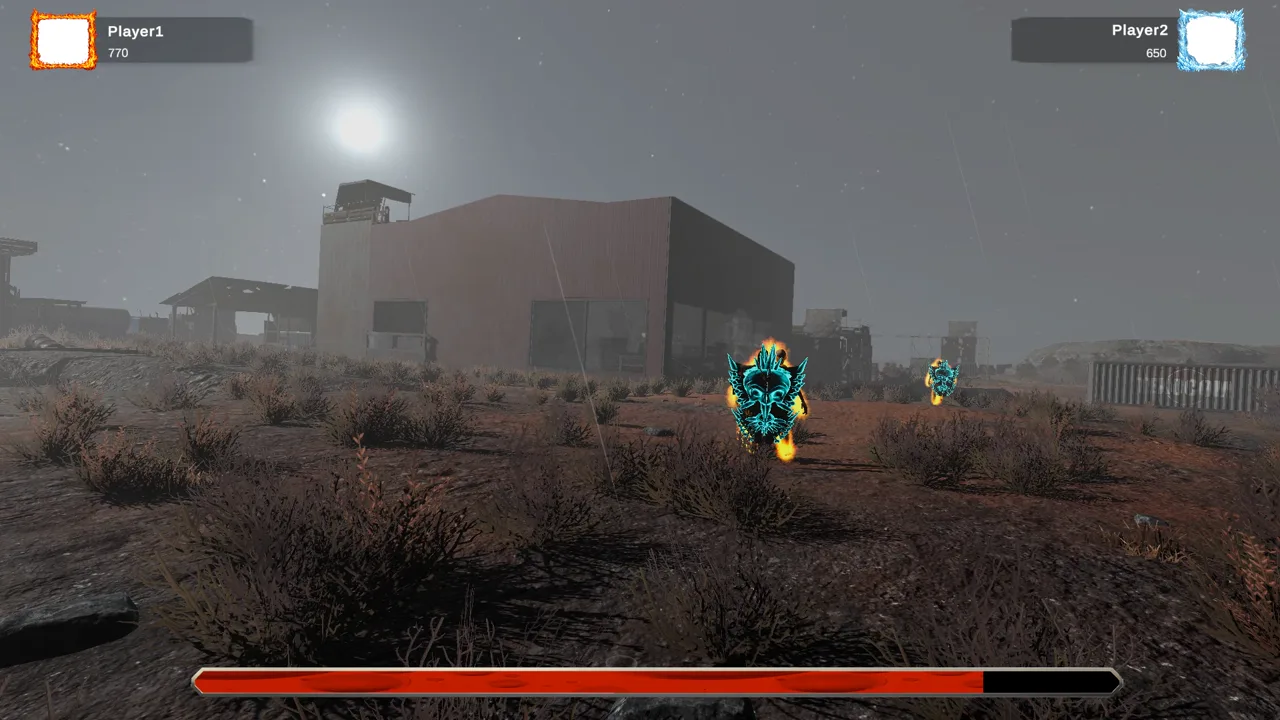
  1. Two fire zombies behind ice shields walking toward the camera on the rail

    Step 1

    0:31

    Rail, after the first Chain Reaction
    What happens
    Only shield zombies spawn, walking slowly toward the camera.
    To teach
    A shield blocks its own colour: one player breaks it, the other makes the kill.
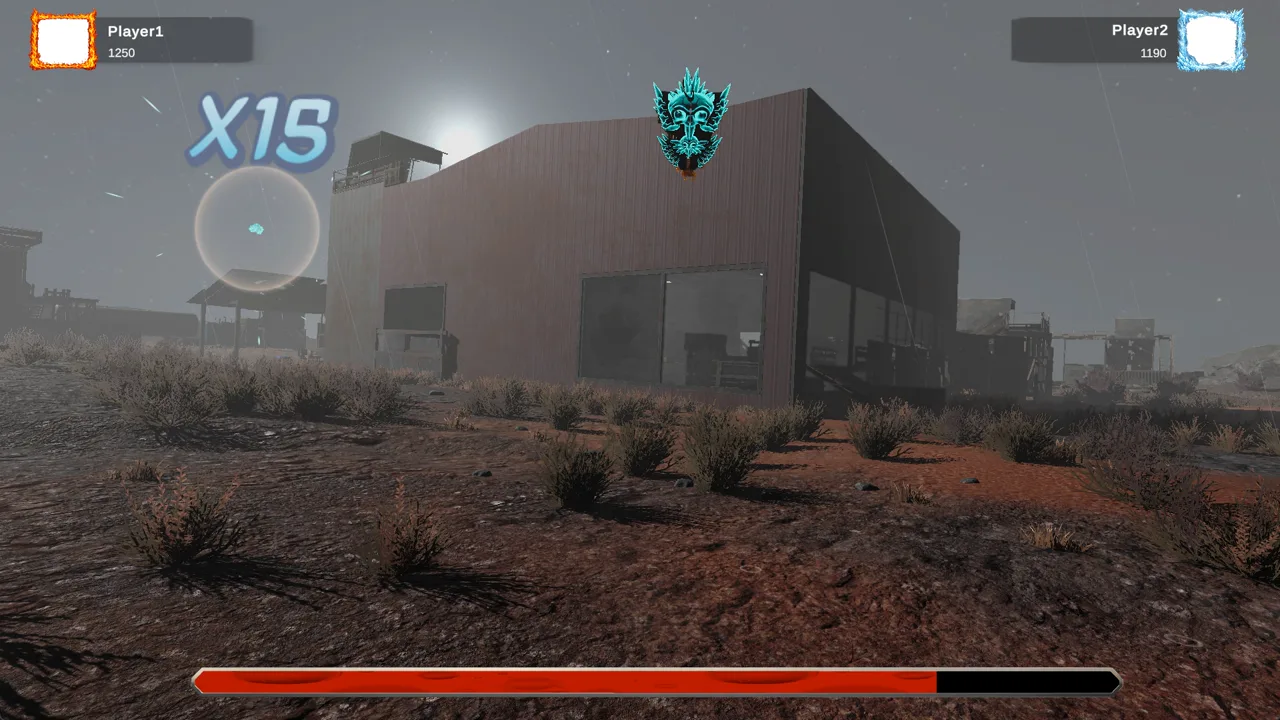
  2. A shielded enemy falling during Raining Enemies

    Step 2

    0:42

    Raining Enemies

    What happens
    Shields turn up in the rain, mixed in at full pace.
    The payoff
    Players read the shield at a glance and know there's an enemy behind it, instead of meeting a new mechanic in an already hard minigame and getting flustered.

Times from the start of play in one run of the final build.

Three strikes

After three fails on the same chain, the game moves the pair on, so no one spends a whole run stuck in one place.

Everything behind a switch

Each new system went in with the old behaviour one checkbox away, so I could play both back to back before committing.

Playtest results

Where runs ended in the final weeks of playtesting.

  1. Wall 1

    0:30

    Chain Reaction

    Passed by the 2nd–3rd play

  2. Wall 2

    0:50

    Raining Enemies

    Passed by the 7th–9th play

  3. Wall 3

    1:45

    Chain Reaction, 2nd visit

    Usually not passed by the 12th play

  4. Win

    3:15

    Victory

    Reached rarely

Each wall is the minigame where runs usually ended, and the play by which pairs got past it.
  • First shots decide it: a miss usually means a fail, which rewards patience over spraying
  • Teaching was only needed on the very first run, and only when both players were new
  • Landed best with partners and close friends, in groups of two or four

What shipped

Reaction windows

  • Chain Reaction, first node

    Before7.0 sAfter2.5 s
  • Chain Reaction, each later node

    Before2.5 sAfter1.2 s
  • Stacked Enemies, each enemy

    Before3.0 sAfter1.2 s
Seconds a player has to hit one target: before my first change (13 June) and in the final build (19 July).
  • Raining Enemies, fall speed

    4.0 became 5.4

  • Raining Enemies, spawn rate at the start

    1.0 per second became 1.25 per second

  • Timer cut on each return visit

    none became 0.2 to 0.3 s

  • Shielded rain enemies

    20%, flat became 25%, plus 15 points per visit

  • Fails before a chain is skipped

    no limit became 3

The other settings that moved between the same two dates.

At handover I left a tuning guide in the project's README: every dial by minigame, split into what changes within a minigame and what changes on each visit.

Cuts and mistakes

Cut: difficulty presets

I built Easy, Intermediate and Hard and cut them in the final week: no time to tune three levels well. The per-visit ramp they sat on stayed.

Cut: Box Reveal

Switched off with a bypass on its trigger rather than deleted, so it can come back.

Mistake: replacing whole files

On 16 July one pasted-in file silently dropped the spawn-rate work and started Raining Enemies twice. Three reverts later, I put features back one at a time.

Mistake: off-screen damage

Moving the rain closer put the outer spawn points off screen, and those enemies still cost health. Spawns now get checked against the camera's view.

What I learned

  1. Tune the number the player feels

    Players feel enemies per second, not seconds between enemies.

  2. Random and fair are different things

    In co-op, who gets the next target is part of the difficulty.

  3. Teach inside the run

    A scripted first encounter did the job a tutorial mode would have.

  4. If you reshape randomness, check the average

    The first streak-breaker felt right and quietly changed the shield rate.

  5. Keep the old version one switch away

    Playing old and new back to back settled questions faster than arguing them.

  6. Change one thing at a time

    Replacing whole files at once was fast until it wasn't.