Skip to content

Case study · Systems design

BOB

A custom Fighter character for Slay the Spire 2. Six fighting stances, and enemies that show their next two turns.

Role
Systems designer, solo
Type
Slay the Spire 2 character mod
Tools
C# and Godot for the mod, a JavaScript simulator, Claude
Status
In development, Aug 2026 – present
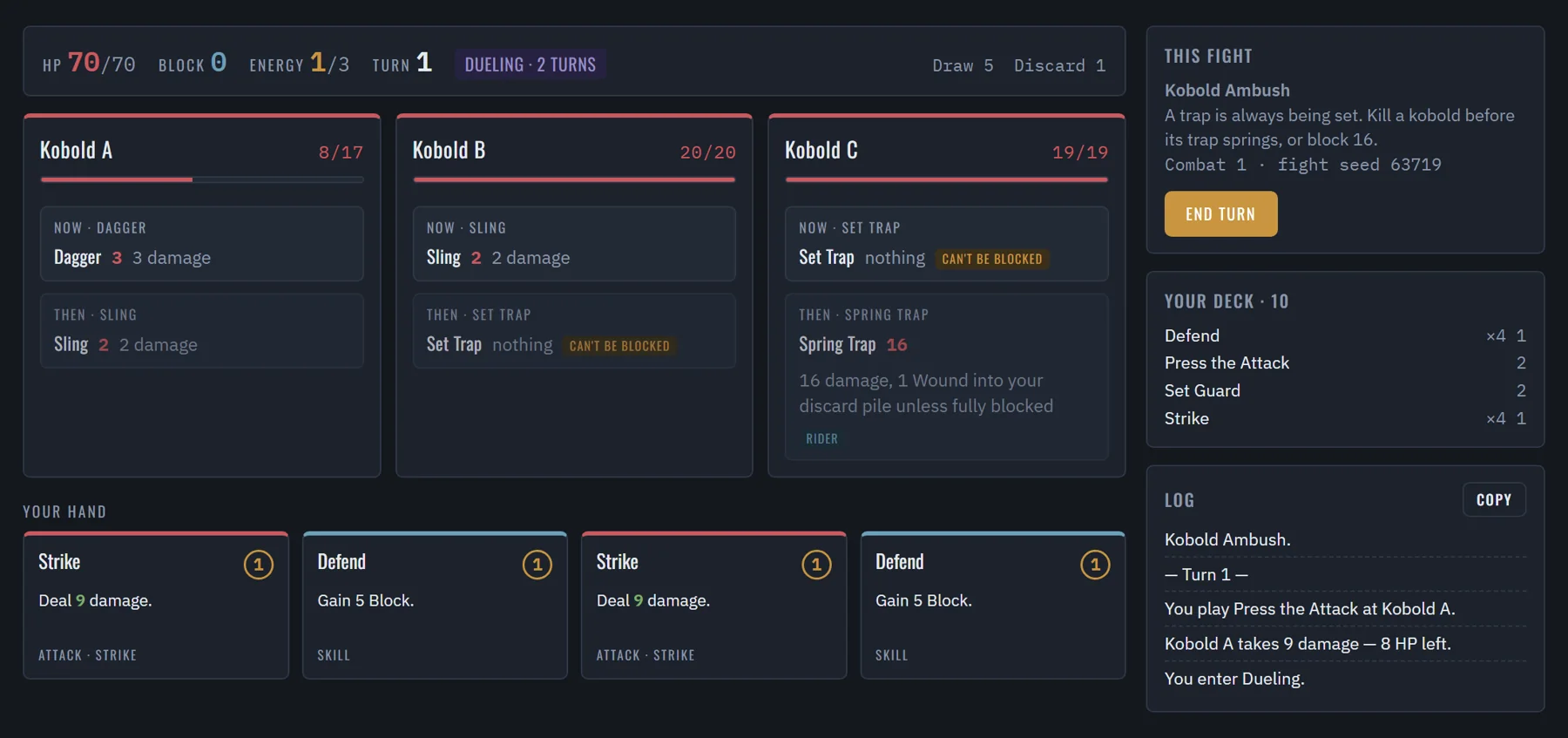
The BOB browser prototype one card into a fight against three kobolds. A badge reads Dueling, 2 turns. Each kobold lists a Now action and a Then action, and one trap is labelled can't be blocked. The Strike cards in hand read Deal 9 damage.Open the screenshot at full size (opens in a new tab)
The browser prototype, one card into a fight. Dueling is active for two turns, so each Strike in hand reads 9 instead of 6. Every kobold shows a Now and a Then action. Tap the image to open it full size.
  • 78

    cards in the reward pool

  • 6

    stances, each with a price

  • 2

    enemy turns shown ahead

  • 700,000+

    simulated runs behind the numbers

What it is today

BOB is a sixth character on Slay the Spire 2's select screen: 70 HP, a 10-card starting deck and a 78-card reward pool (25 Common, 32 Uncommon, 21 Rare). In a BOB run, Act 1's normal fights are five enemies made for it.

It began in August 2026 as a class design brief and spent its first month as a browser prototype, where I could change a number and test it the same hour. In late September I rebuilt it as a mod, so the cards could be played inside a full run with the real game's map, shops and bosses around them.

Built and playable

  • The character, its starting deck and all 78 reward cards
  • Six stances and the two-turn telegraph
  • Five Act 1 enemy fights
  • A log of every turn played, stamped with the build that played it

Still the base game's

  • Relics, potions, card art and sounds
  • Elites, bosses, and Acts 2 and 3
  • Card upgrades, which only rename a card for now
  • It isn't on the Steam Workshop yet

The systems

Three rules give BOB its identity. Each one changes what a turn asks of the player.

Two turns of warning

Slay the Spire shows what each enemy will do this turn. BOB shows this turn and the next, with exact numbers, and nothing hidden happens on the enemy's turn. Thirteen cards work with that information. Seven read it and pay off when you plan around it, five edit it by delaying, swapping or cancelling an action, and one pays for editing.

Block is a threshold

In Slay the Spire a debuffing attack lands whether or not you blocked it. In BOB a status effect only lands if its hit got through, so blocking a hit completely also denies whatever rode in on it. The question each turn becomes whether you can reach the number, not how much you can soak.

That makes the numbers themselves the design. The Goblins have 17 HP on purpose: a healthy player kills one in exactly one turn, because three Strikes deal 18, and a Weakened player can't. That window only exists between 16 and 18 HP.

Stances priced at the door

A stance boosts every Attack you play for two turns. That's the same length as the telegraph, so choosing a stance means answering both enemy turns you can see.

“Let's balance it not through the stance, but with the cost needed to enter the stance.”
From my design log, 16 September

So a stronger stance costs more Energy to enter, and the strongest costs a whole turn. Archery is the one exception. It's free to enter and punishes you instead.

  • SuperiorityEnergy 1

    For every 2 Attacks you play, draw a card. A Strike counts as 2.

  • DuelingEnergy 2

    Strikes deal +3 damage per hit, other Attacks +1.

  • DefenseEnergy 2

    Each Strike also gives 2 Block, each other Attack 1.

  • Two-Weapon FightingEnergy 2

    For every 2 Attacks you play, add a free Dagger to your hand. A Strike counts as 2.

  • Great Weapon FightingEnergy 3

    Strikes deal +6 damage per hit, other Attacks +3.

  • ArcheryEnergy Free

    Strikes deal +4 per hit, other Attacks +2. Taking unblocked damage costs you 1 Energy next turn.

    Entered by playing an Arrow

The six stances. Numbers are the current balance patch and are still marked provisional in my rules document.

Balancing with data

I balance against two sources and trust neither alone: a bot that plays the real game hundreds of thousands of times, and my own hands on the same build.

The bot drafts at random for 30,000 runs. A card's rating is how many more fights a run went on to clear after picking it, compared with runs that picked something else at the same point. Skipping the reward rates about −0.20. Each change is then tested on 10,000 more runs that reuse the same seeds, so only the change differs. In total that's more than 700,000 simulated runs across 11 batches.

Does drafting matter? Runs finished

  • Takes no reward cards0%
  • Picks reward cards at random25.6%
  • Picks the best-rated card84.5%
How often the bot finishes the ten-fight test run, by how it drafts. The two lower bars are the current patch (30,000 and 10,000 runs). The 0% bar was measured on the first version with an earlier bot (12,000 runs). The bot never misreads the board, so these are ceilings for a careful player, not forecasts for a person.

The Kobold Ambush

9.9 → 4.8 HP lost

Problem
In my three hand-played runs, this one normal fight caused 73% of all the HP I lost to normal fights: 38, 16, 21 and 18 HP. The bot agreed in direction, at 9.7 HP against 1.3 to 4.3 for the other four.
Fix
The assistant proposed making every trap fire a turn later. I ruled instead that a dead kobold's trap doesn't fire, which reversed an exception I'd made five days earlier. We ran all four versions on the same seeds.
Result
My rule cut the fight to 4.8 HP and lifted finished runs from 77.8% to 84.5%. The assistant's fix reached 5.1. Mine was adopted because it removes a special case instead of adding one.
  • Original rule: a set trap fires even if its kobold is dead

    9.9 HP lost

    Runs finished 77.8%

  • The assistant's fix: every trap fires a turn later

    5.1 HP lost

    Runs finished 83.9%

  • My rule: a dead kobold's trap doesn't fireAdopted

    4.8 HP lost

    Runs finished 84.5%

  • Both changes together

    3.1 HP lost

    Runs finished 86.4%

10,000 bot-played runs per version, same seeds and same drafts. Afterwards, people on the playtest site still lost 9.0 HP per ambush across four fights, so the next step is marking which kobold holds the trap.
Runaway cards

Spread 0.87 → 0.63

Problem
Three cards rated far above everything else, at +0.85, +0.83 and +0.83, and four of the six best cards made Arrows. The middle 80% of cards spanned 0.87.
Fix
Arrows lost 2 damage. Bulwark went from 2 Dexterity to 1, Ready from 7 Block to 5, and Light Step from 5 Block to 4. I kept Light Step repeatable where the first proposal made it single-use.
Result
Every changed card moved toward the middle and none overshot. The spread fell to 0.63 while difficulty held: a well-drafted run finished 83.7% of the time before and 84.5% after.
-0.40.0+0.4+0.8Before (v0.1)middle 80% span 0.87After (v0.2d)middle 80% span 0.63

Each dot is one card the bot plays regularly (59 before, 61 after), placed by its rating from 30,000 random-draft runs. The shaded band is the middle 80% of cards. The dashed line is the rating of skipping the reward.

Cards that cost HP

−0.28 → +0.19

Problem
My rule is that taking damage is always priced as a cost, and the numbers should make you ask whether it's worth it. Players were answering no every time: I took 1 of the 9 self-damage cards I was offered, and the group rated −0.22.
Fix
The assistant made five of them cost 1 HP less. I reversed the direction: keep the price and raise the payoff. Reckless Attack went from 16 damage to 20.
Result
Reckless Attack went from −0.28 to +0.19 and the group from −0.22 to −0.07. Two cards still sit at −0.24, so this is only partly solved and they stay on my watch list.
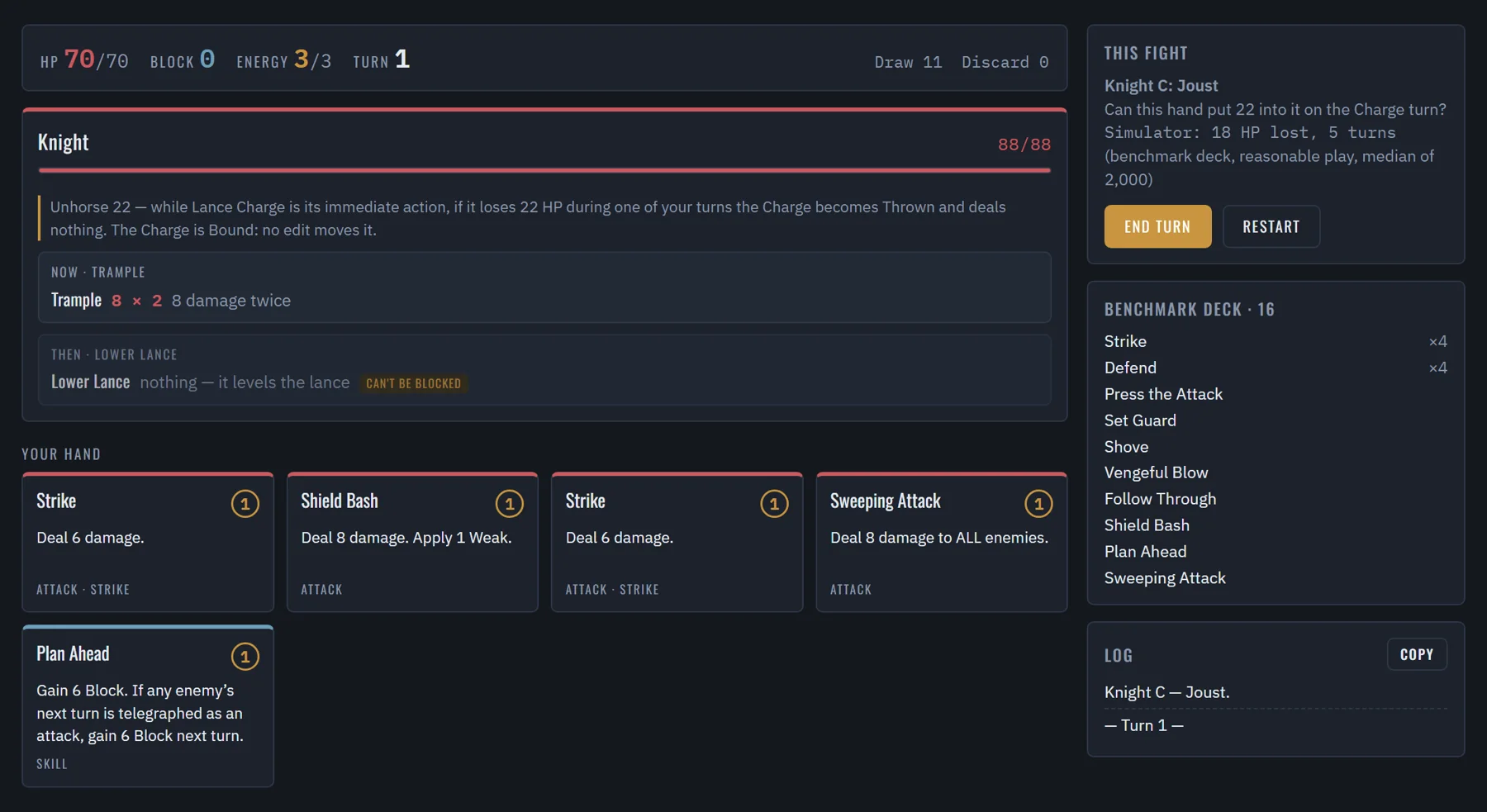
The BOB browser prototype at the start of an elite fight against a Knight. A panel reads Simulator: 18 HP lost, 5 turns, benchmark deck, reasonable play, median of 2,000.Open the screenshot at full size (opens in a new tab)
Every elite fight in the prototype shows the simulator's median beside it, so a fight I've just played can be compared with the bot's on the spot. Tap the image to open it full size.

What the data got wrong, and what's still broken

The numbers above are only worth something if I also know where they fail. These are the gaps I've measured so far.

The simulator against my own hands

I tuned twelve elite fights to cost between 18 and 30 HP. Then I played all twelve. The real range was 17 to 58. The bot is better than a person at managing rates and worse at spotting an all-or-nothing moment, so its medians can't rank fights against each other.

Simulator medianWhen I played itHP lost, out of 70

  • Knight D23 simulated, 58 played
  • Forest troll A30 simulated, 44 played
  • Owlbear D29 simulated, 40 played
  • Wolf pack C20 simulated, 36 played
  • Plant pack D22 simulated, 35 played
  • Forest troll B26 simulated, 33 played
  • Hobgoblin warband D24 simulated, 32 played
  • Plant pack A20 simulated, 30 played
  • Forest troll D18 simulated, 23 played
  • Owlbear C19 simulated, 19 played
  • Knight C18 simulated, 19 played
  • Hobgoblin warband A21 simulated, 17 played
Each row is one elite fight: the simulator's median over 2,000 fights, and what I lost when I played it once. I won all of them. Thirteen of the fourteen fights used the same seed, which opens with a strong hand against groups, so read the direction and not the exact gaps. Two fights are named by description while their creature is renamed.

Predictions, written down first

Powers rated badly, and the belief was that the bot couldn't play them. Before it was taught to, twelve predictions went into a file. Four held and eight failed. The bot had been playing Powers fine. Most of them lose to a plain card because BOB's fights are short, at 3 to 4.5 turns for a normal fight, so a card that pays over time rarely has time to pay.

The signature cards are the weakest picks

Cards that edit the telegraph are the most distinctive thing in the design, and they still rate at or below skipping the reward after two rounds of buffs: −0.23, −0.23 and −0.21, against −0.19 for taking nothing. My notes say this wants design, not a number.

Very few people have played it

The playtest site has four runs from three testers, one of them finished. I've played five runs in the mod, and one of those reached the Act 1 boss and beat it. Nobody but me has been asked yet whether it's fun.

Gear has never been played

The original pitch was equipment that changes what your cards do, in place of relics. Nine pieces are designed out of a planned 150, and none is in any build. The mod uses the base game's relics.

How it got here

  1. Aug 30Starts as a class design brief. I rank the pillars and rule out lanes.
  2. Sep 9Enemies show two turns ahead instead of one.
  3. Sep 16Stances arrive, and the first browser prototype.
  4. Sep 19A combat simulator, and six elite encounters with five variants each.
  5. Sep 20I hand-play all 12 shortlisted elites and three full runs. The first balance patch is adopted the same day.
  6. Sep 21The prototype goes online as a playtest site that records every run.
  7. Sep 23Rebuilt as a Slay the Spire 2 mod: its own character, starting deck and two-turn telegraph.
  8. Sep 24Every reward card is in the mod and checked in game.
  9. Sep 30A study of why Powers rate badly, with predictions written down first.

Moving to a mod was a trade. It gave the cards the real game's feel and a full run to live in, and it means every rules change now has to be made twice, once in the browser build where the numbers are measured and once in the mod. Several rulings went the other way too: questions the mod forced me to answer are now in the rules for both.

What I did, and what Claude did

I built BOB with Claude as a design assistant and programmer. I made the design and every decision in it; Claude wrote the code and ran the numbers. The decision log records who proposed and who settled each of its 97 entries.

Me

  • Set the pillars and the rules the numbers answer to: stances priced by entry cost, and damage to yourself always priced as a cost.
  • Designed the core mechanics: the two-turn lookahead, the stances, Archery, the Hurt rule, and the rule that a card with Strike in its name gets every Strike bonus.
  • Settled all 97 decisions in the log, and proposed 39 of the 63 that record a proposer.
  • Overruled the assistant where it mattered: the kobold rule, the direction of the self-damage fix, and the stance rework.
  • Played it by hand: 15 elite fights and 4 full runs on the prototype, 2 runs on the playtest site and 5 in the mod.
  • Caught bad evidence, including a “3-turn kill” that only worked with a perfect draw. That one led to a written test protocol.

Claude

  • Wrote the code: the simulator, the run-playing bot, the browser prototype, the playtest site and the mod's C#.
  • Ran every simulation batch and wrote the reports.
  • Proposed the first balance patch, which I revised three times before adopting.
  • Drafted batches of candidate cards, encounters and events that I cut down and reworked.
  • Kept the rules document and decision log, and wrote the design reviews I asked for.

Play the prototype

Ten fights, one rest and three events, starting from the 10-card deck. It takes about 15 minutes. It's the plain balance build, so expect panels and numbers, not art.

Open it in a new tab

The prototype records what happens in each run (cards picked, fights, time taken) under a random ID, to help balance the game. It stores no name, email or IP address.

What's next

  • Pick one variant for each Act 1 elite and bring them into the mod.
  • Show the total incoming damage on screen. Most run-ending deaths so far were to a sum the screen didn't add up.
  • Get gear into a build that can be played.
  • Put it in front of more people, and ask them what they remember.